

What Is the Snowball Method?
The debt snowball method is a strategy for paying off multiple debts by starting with your smallest debt first and working toward your largest. You make minimum payments on your other debts while putting extra money toward the smallest balance. Once it’s paid off, you roll that payment into the next-smallest debt and repeat.
How Does the Snowball Method Work?
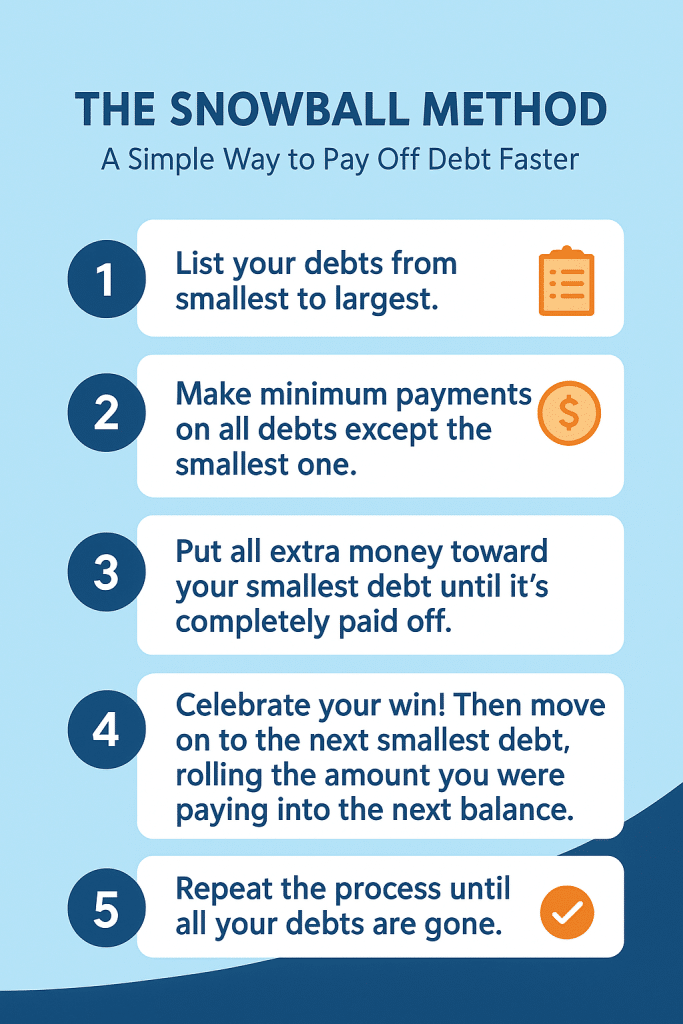
- List your debts from smallest to largest. Ignore the interest rates for now.
- Make minimum payments on all debts except the smallest one.
- Put all extra money (your “snowball”) toward the smallest balance.
- Pay off that debt completely.
- Apply that freed-up payment to the next-smallest debt.
- Repeat until all debts are gone.
Over time, the payments you can put toward each debt grow larger and larger, creating powerful momentum.
Why the Snowball Method Works
The snowball method isn’t just about numbers—it’s about motivation. Here’s why it’s so effective:
- Quick wins keep you motivated. Paying off a small debt quickly gives you confidence to keep going.
- Momentum builds naturally. Each time you eliminate a debt, you have more money to put toward the next one.
- It’s easy to follow. You don’t need fancy calculators or financial knowledge—just a list and a plan.
- You stay engaged. Many people quit debt repayment because it feels slow. The snowball method keeps you emotionally invested.
Think of it as training your brain for success—small victories lead to bigger victories.
Example of the Snowball Method in Action
Let’s look at an example. Imagine you have four debts:
- Credit Card A: $400
- Credit Card B: $1,000
- Car Loan: $6,000
- Student Loan: $18,000
Here’s how the snowball method would play out:
- Pay minimums on everything but Credit Card A.
- Attack Credit Card A with all extra money until it’s gone.
- Roll the payment from Credit Card A into Credit Card B.
- After that’s gone, roll both payments into the Car Loan.
- Finally, use the full snowball to crush the Student Loan.
By the time you reach your largest debt, you’ll be making huge payments compared to where you started—helping you pay it off and become debt-free much faster than if you were spreading your money thinly.
How Long Does It Take to Pay Off Debt With the Snowball Method?
The big question: just how quickly can you expect to eliminate your debt with the snowball method?
While the answer depends on your specific balances, payments, and how much extra you can contribute, the snowball method is designed to help you make steady, noticeable progress right from the start.
Let’s break it down with a sample timeline:
- Small debts can vanish fast. If you put extra money (say, from picking up a side gig or trimming your budget) toward your smallest balance, some debts might disappear in just a month or two.
- Momentum speeds things up. As each debt drops off, your available payment for the next one grows—meaning each following payoff happens quicker than the last.
- $20,000 paid off in under two years? Absolutely possible. For example, someone starting with $20,000 spread across several debts (like medical, credit cards, car, and student loans) and adding $500–$600 extra to their minimum payments could clear all balances in less than 24 months.
- Every situation is unique. The more you can add to your payments, the faster you’ll wipe out debts. Some people clear everything in a year, while others may take two to three years—still much faster than making only minimum payments.
The key? Focusing on one balance at a time and rolling over each victory into tackling the next, you might be surprised at how quickly your snowball picks up speed.
With a strong plan and a little determination, you could find yourself debt-free far sooner than you thought possible!
Paying Off $20,000 in Debt in Under Two Years: How the Snowball Method Makes It Possible
Let’s break down how you could tackle $20,000 in debt in less than two years—yes, really—using the snowball method.
Imagine you have four debts:
- Medical Bill: $500 (minimum payment: $50)
- Credit Card: $2,500 (minimum payment: $63)
- Car Loan: $7,000 (minimum payment: $135)
- Student Loan: $10,000 (minimum payment: $96)
Here’s what your game plan might look like:
- Focus on the Smallest Debt First: Pay minimums on everything, but throw every extra cent at the $500 medical bill. If you pick up a side gig or trim your budget and can add $500 to your efforts, you’ll knock out that medical bill in just one month.
- Redirect Freed-Up Payments: Now take the $550 you were paying toward the medical bill (the $50 minimum plus the $500 extra) and add it to the credit card minimum payment. That means you’re putting $613 a month toward your credit card debt. In about four months, you’re done with it.
- Roll Into the Next Debt: Next up, the car loan. Combine the $613 from the paid-off credit card with the car loan’s $135 minimum, and you’re now paying $748 a month on your car loan. It’ll disappear in less than nine months.
- Bring Out the Big Guns for the Last Debt: Once that’s gone, add your car loan payment to the student loan minimum. If you can stretch your budget a bit further—perhaps another $100 per month—you’re now shelling out $944 monthly toward the student loan debt. That final balance won’t stand a chance and will be cleared out in about nine months.
With each payoff, your payments grow larger—your “snowball” gains momentum. This focused approach means you could be debt-free in just under two years, paying off $20,000 without feeling like you’re getting nowhere. And the motivation you build with every debt you conquer? That just might help you reach your goals even faster.
Snowball Method vs. Avalanche Method
You may have also heard of the avalanche method, another debt payoff strategy. Instead of starting with the smallest balance, the avalanche method targets the highest-interest debt first to save money on interest.
- Avalanche method: Saves more money in interest but may take longer to see results.
- Snowball method: May cost slightly more in interest but delivers faster wins to keep you motivated.
If you’re highly disciplined and patient, the avalanche method could be a good choice. But if you’ve ever felt discouraged or stuck when paying off debt, the snowball method is more likely to keep you on track.
Why Motivation Matters
The avalanche method makes perfect mathematical sense—you focus your energy on the debt costing you the most in interest. The catch? That high-interest debt is often also the biggest balance. It can feel like you’re chipping away forever before you actually see any progress. For many people, that slow progress leads to frustration and burnout. You’re still making minimum payments on all those smaller debts, watching them linger month after month.
With the snowball method, you start by paying off your smallest debt first—no matter the interest rate. That means you’ll score a quick win right away, knocking out a debt completely. Each time you pay off a balance, your confidence and momentum build. You’re no longer surrounded by a crowd of annoying little debts. Instead, you’re rolling those payments into the next target, creating a snowball effect that grows stronger with each step. That sense of accomplishment can be the fuel you need to keep going, even if it means spending a little more on interest in the long run.
Ultimately, the “best” strategy is the one you’ll actually stick with. Choose the method that fits your personality and keeps you motivated for the journey ahead.
Tips For Success
The snowball method is simple, but you can make it even more powerful with a few smart habits:
1. Create a Realistic Budget
Know exactly how much money you can put toward your snowball each month. Even an extra $50 or $100 makes a big difference over time.
2. Cut Small Expenses
Little savings add up. Skip dining out for a month, cut unused subscriptions, or shop for cheaper insurance. Redirect those savings to your snowball.
3. Boost Your Income
Side jobs, freelance work, or selling unused items can supercharge your snowball. Even temporary extra income can help you crush debt faster.
4. Automate Payments
Set up automatic minimum payments so you never miss one, and then make extra snowball payments manually to stay engaged.
5. Celebrate Milestones
Paying off a credit card or loan is a big win—so celebrate! Reward yourself in a small but meaningful way (without adding more debt).
Common Mistakes to Avoid With the Snowball Method
While the snowball method is powerful, watch out for these pitfalls:
- Adding new debt. Don’t cancel out your progress by running up new balances.
- Skipping your emergency fund. Unexpected expenses can throw off your snowball. Build a small savings cushion first.
- Forgetting long-term goals. The snowball method helps with debt, but don’t neglect retirement savings once your debt is under control.
To make the most of your snowball journey, keep these steps in mind:
- List all your nonmortgage debts from smallest to largest balance. Ignore interest rates for now—focus on balances.
- Work the snowball method into your budget. Look for extra room each month (even $20 here or $50 there) to throw at your smallest debt.
- Make minimum payments on everything except your smallest debt. Attack that one with everything you’ve got.
- Once a debt is paid off, roll that full payment into the next smallest debt. This keeps your momentum (and payments) growing.
- Repeat until every debt is gone. Once you’re debt-free, you can shift focus to building a fully stocked emergency fund (aim for 3–6 months of expenses).
Staying organized and sticking to these steps will help you avoid common mistakes, crush your debt, and set yourself up for long-term financial health.
When Should You Hit Pause on Your Debt Snowball?
Life has a way of throwing curveballs just when you think you’re gaining momentum. There are certain situations where it makes sense—maybe even necessary—to temporarily pause your debt snowball, focus on the crisis at hand, and then pick back up as soon as you’re able.
Common reasons to hit pause include:
- Welcoming a new baby. Childbirth brings joy—and plenty of expenses. It’s wise to prioritize medical bills and immediate family needs before charging full speed ahead on debt.
- Unexpected job loss. If your income suddenly drops, cover your essentials first. Protect your four walls: food, housing, transportation, and utilities.
- Medical emergencies. Major health issues (for yourself or a family member) often mean new bills and shifting priorities until things stabilize.
- Major life transitions. Divorce, separation, or the loss of a loved one can reshape your finances overnight.
- Large, time-sensitive bills. An unplanned tax bill, for example, may require all hands on deck until it’s settled.
Remember, pausing doesn’t mean quitting. Think of it as a temporary pit stop—once you’re back on your feet, get your debt repayment rolling again and keep that momentum going.
Is the Snowball Method Right for You?
The snowball method works best if:
- You need quick wins to stay motivated.
- You’ve struggled with debt repayment in the past.
- You prefer a clear, simple system you can stick to.
If you’re laser-focused on saving every penny in interest, the avalanche method may be a better fit. But for most people, the snowball method provides the perfect balance of structure and motivation.
Final Thoughts
The snowball method isn’t just about numbers—it’s about psychology. By focusing on small victories, you build confidence, gain momentum, and create a clear path toward financial freedom.
Debt doesn’t have to control your life. With the snowball method, you can take back control—one debt at a time—until you’re completely debt-free.
Start today. List your debts, make your plan, and push your first snowball downhill. Before you know it, your financial future will look brighter than ever
If you need additional help, contact one of our credit counselors for a free consultation.