

An unexpected medical bill can put your finances under enormous pressure. Even with health insurance, you may face deductibles, copayments, coinsurance, or charges for services your plan doesn’t cover. If you’re uninsured, a single hospital visit or medical procedure can create thousands of dollars in debt.
If you’re wondering what to do if you can’t pay your medical bills, you may have more options than you realize. Depending on your circumstances, you may be able to correct billing errors, qualify for financial assistance, negotiate an affordable payment arrangement, or find help managing medical debt alongside your other financial obligations.
The important thing is to understand your options before putting a large medical bill on a credit card or agreeing to a financing plan you may struggle to repay.
Here are nine steps to help you address medical bills you can’t afford and determine the best way forward.
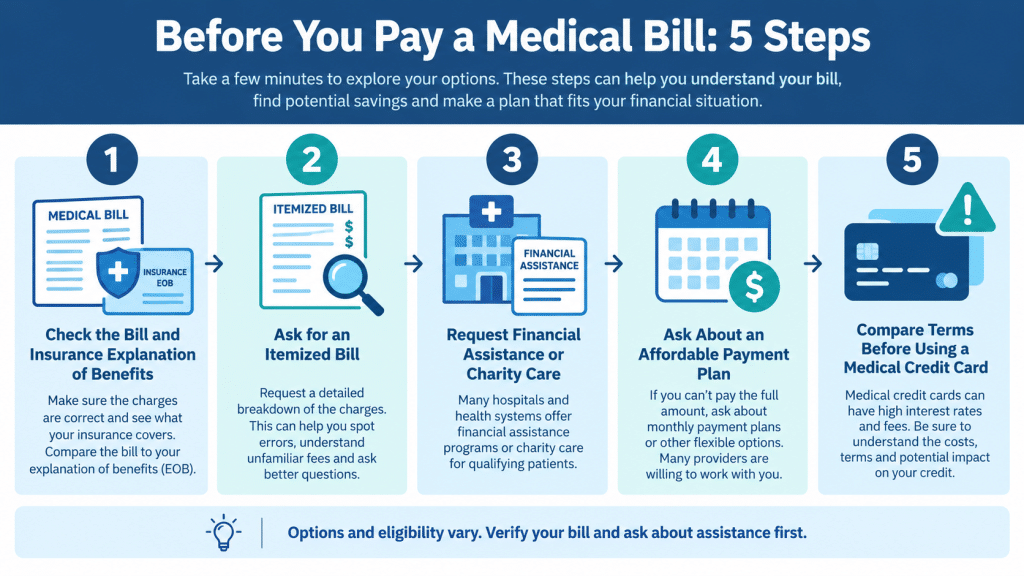
1. Review Your Medical Bill for Errors
Before paying a large medical bill, make sure the amount is correct.
Medical bills can be complicated, particularly when several providers, insurance companies, and billing departments are involved. A statement may reflect an insurance claim that hasn’t been processed, a service that was billed incorrectly, or an amount that doesn’t match your insurance coverage.
Start by gathering your medical bill, insurance explanation of benefits (EOB), and any relevant receipts or previous statements.
Check the following:
- Patient information: Make sure the bill belongs to you and the services were provided to the correct patient.
- Services received: Confirm that the listed procedures, tests, and appointments match the care you received.
- Insurance payments: Check whether your insurer has processed the claim and applied its payment correctly.
- Deductibles and copayments: Compare the amount you’re being asked to pay with your insurance benefits.
- Duplicate charges: Look for services or fees that appear more than once.
- Out-of-network charges: If you received an unexpectedly high bill, check whether federal or state surprise-billing protections may apply.
Your explanation of benefits is not necessarily a bill. It explains how your insurance company processed a claim and what portion it believes you may owe.
If something doesn’t look right, contact the provider’s billing department and your insurer. Ask for an explanation of the charges and request corrections when appropriate.
You can also learn about your rights and billing protections through the Consumer Financial Protection Bureau’s medical bill guidance.
Why this matters: You shouldn’t have to pay an amount you don’t owe. Resolving a billing problem may reduce the amount you need to pay or help you identify the next steps.
2. Request an Itemized Bill and Ask Questions
If your statement contains unfamiliar charges or a large balance, request an itemized bill.
An itemized statement breaks down the services, procedures, supplies, and other charges included in your total.
Review it carefully and ask the billing department to explain anything you don’t understand.
Questions you might ask include:
- What does this particular charge cover?
- Was this service billed separately by another provider?
- Has my insurance company processed every applicable claim?
- Are there any discounts or financial assistance programs available?
- Is this the final amount I owe?
Keep notes of your conversations, including the date, the name of the person you spoke with, and any promised follow-up.
If you dispute a charge, explain the reason clearly and ask the provider how to submit the dispute in writing.
Don’t assume that every unfamiliar charge is an error. The purpose of reviewing an itemized bill is to understand what you’re being charged for and determine whether the amount is accurate.
3. Ask About Hospital Financial Assistance or Charity Care
One of the most important steps is to ask whether you qualify for financial assistance.
Some hospitals and healthcare organizations offer programs that reduce or eliminate eligible medical bills for patients who meet certain income or other eligibility requirements. These programs are often called financial assistance or charity care.
Certain tax-exempt nonprofit hospitals are required to maintain financial assistance policies under federal law. Eligibility, covered services, and application procedures depend on the hospital’s policy and applicable law.
To find out whether assistance is available:
- Contact the hospital’s financial assistance or patient financial services department.
- Ask for its written financial assistance policy.
- Request the application and eligibility requirements.
- Ask what income documents or other records you need to provide.
- Find out whether the policy can apply to an outstanding bill or a bill already sent to collections.
You may need to provide recent pay stubs, tax documents, household information, or other evidence of financial circumstances.
If you have already received a bill, don’t assume it’s too late to apply. Ask the hospital whether it will review your application and how it handles collection activity while an application is pending.
Also ask whether the program covers only hospital charges or includes bills from separate physicians, laboratories, or other providers. Coverage can vary.
You can find additional information about medical financial assistance through the Consumer Financial Protection Bureau.
Tip: Ask about financial assistance before using a medical credit card or taking out a loan to pay the bill. If you qualify for assistance, borrowing may be unnecessary.
4. Explore Insurance Appeals and Other Assistance Programs
If your insurance company denied a claim or paid less than you expected, find out why before assuming you must pay the entire balance.
Read the explanation of benefits and any denial letter. Look for the reason the claim was denied, the deadline for appealing, and instructions for requesting a review.
Depending on the situation, you may be able to correct missing information, request that the provider resubmit a claim, or appeal the insurer’s decision.
If you believe a denial is incorrect, follow the appeal instructions and keep copies of supporting documents.
You should also investigate other programs that may help with medical costs.
Depending on your circumstances, these may include:
- Medicaid: You may qualify based on your state, income, household circumstances, and other eligibility rules.
- Medicare assistance programs: Eligible Medicare beneficiaries may qualify for programs that help with certain premiums and cost-sharing expenses.
- Prescription assistance: Some pharmaceutical manufacturers, nonprofit organizations, and public programs offer help with eligible medication costs.
- Veterans’ benefits: Eligible veterans may qualify for assistance with certain healthcare expenses or outstanding VA medical charges.
- State and local programs: Your state or local government may provide information about healthcare coverage, medical assistance, or consumer protections.
Eligibility and coverage vary. Applying for assistance does not guarantee that an existing bill will be covered, so ask each program what expenses it can address and whether any deadlines apply.
For help identifying federal benefit programs, visit USA.gov’s benefits resources.
5. Negotiate an Affordable Medical Bill Payment Plan
If the bill is accurate and you don’t qualify for enough financial assistance to eliminate it, ask the provider about a payment plan.
Many hospitals and medical providers have arrangements that allow eligible patients to pay an outstanding balance over time rather than in one lump sum.
Before agreeing to a plan, ask:
- Is the plan interest-free?
- Is there an enrollment or administrative fee?
- What is the minimum monthly payment?
- How long will repayment take?
- What happens if I miss a payment?
- Will the account be referred to collections while I’m making payments?
- Can I apply for financial assistance while the balance is outstanding?
Don’t agree to a monthly payment simply because the provider offers it. Make sure the amount fits your budget after accounting for housing, food, utilities, transportation, insurance, and other essential expenses.
If the proposed payment is too high, explain your financial situation and ask whether a smaller payment or another arrangement is available.
What to Say When Calling the Billing Department
You can use this script as a starting point:
“Hello, I’m calling about my outstanding medical bill. I want to resolve the balance, but I’m unable to afford the full amount right now. Could you tell me whether I qualify for financial assistance or an interest-free payment plan? If I don’t qualify for assistance, I’d like to discuss a monthly payment that fits my budget.”
Ask for any agreed-upon terms in writing.
A payment plan can make a bill more manageable, but it doesn’t automatically reduce the amount owed. Be sure you understand the total cost and consequences before enrolling.
6. Be Careful With Medical Credit Cards and Financing Offers
Medical credit cards and healthcare financing plans may seem attractive when you’re facing a large bill. They can allow you to spread payments over time, but they also introduce risks.
Some products offer promotional periods with deferred interest. That means interest may accumulate under the agreement even if you don’t initially see it added to your balance. If you fail to pay the required amount in full before the promotional period ends, you may owe substantial interest.
Before accepting a medical financing offer, ask:
- What is the interest rate after the promotional period?
- Is the offer truly interest-free, or is interest deferred?
- What happens if I don’t pay the balance in full by the deadline?
- Are there late fees or other charges?
- Can I afford the required payments without using additional credit?
Compare the financing terms with any payment arrangement offered directly by your healthcare provider.
The Consumer Financial Protection Bureau warns consumers to investigate financial assistance and insurance coverage before agreeing to medical credit cards or other financing products.
Read its guide to medical credit cards and payment plans.
Important: Moving a medical bill onto a credit card doesn’t make the debt disappear. It changes the form of the debt and may change the interest rate, fees, and credit-reporting consequences.
7. Understand What Happens if a Medical Bill Goes to Collections
If you can’t pay a medical bill, the provider may eventually refer the account to a collection agency or sell the debt, depending on the circumstances and applicable rules.
Receiving a collection notice can be stressful, but it doesn’t mean you should ignore it.
Start by reviewing the notice and confirming that the debt is yours and that the amount is accurate.
If you don’t recognize the debt or believe the amount is incorrect, you may have the right to dispute it. Federal law provides specific protections concerning debt collection, including procedures for disputing a debt and requesting verification.
Pay attention to the deadlines stated in the notice. If you believe the debt is inaccurate, consider getting advice promptly about how to preserve your rights.
You should also ask whether the original provider still offers financial assistance and whether it can review the account. The availability of assistance after an account enters collections depends on the provider’s policies and applicable law.
If a lawsuit has been filed, do not ignore the court papers. Legal deadlines can be important, and you may want to seek legal assistance.
For more information, see the CFPB’s guide to medical bills sent to collections.
8. Understand How Medical Debt Can Affect Your Credit
Medical debt and credit reporting can be confusing because different rules apply depending on the type of account, the reporting company, and the circumstances.
The nationwide credit reporting companies have adopted policies that exclude paid medical collections, medical collections less than one year old, and medical collections with an initial reported balance under $500 from their credit reports.
However, you should not assume that every medical-related debt is excluded from credit reporting.
For example, a medical credit card or a general-purpose credit card used to pay a healthcare bill is a credit account, not the same thing as an unpaid medical collection. Missed payments on those accounts may affect your credit.
Federal and state laws may also provide additional protections in particular circumstances.
If you discover medical debt on your credit report, review the account information and check whether it is accurate. If you believe the information is incorrect, dispute it with the relevant credit reporting company and the company that furnished the information.
You can learn more from the CFPB’s current guidance on medical bills and credit reporting.
Don’t make financial decisions based on the assumption that unpaid medical debt can never affect your credit.
9. Consider Credit Counseling if Medical Bills Are Part of a Larger Debt Problem
Sometimes, medical bills are only one part of a broader financial challenge.
You may also be carrying credit card balances, personal loans, or other unsecured debts. Even if a hospital agrees to a manageable payment plan, your overall budget may remain stretched too thin.
In that situation, it can help to look at your complete financial picture rather than treating every bill separately.
A nonprofit credit counseling organization can review your income, expenses, debts, and financial goals and help you understand potential repayment options.
Depending on your circumstances, a counselor may discuss:
- Creating a realistic household budget.
- Prioritizing essential expenses and required payments.
- Contacting creditors about hardship arrangements.
- Developing a self-directed debt repayment strategy.
- Evaluating whether a debt management plan may be appropriate.
A debt management plan is generally designed for eligible unsecured debts, often including credit card balances. Whether a particular medical bill can be included depends on the organization, creditor, and program terms. Do not assume that every hospital bill or medical collection is eligible.
Credit counseling also does not automatically erase medical debt or guarantee lower payments. Its value is in helping you understand your options and assess whether a structured plan is appropriate for your circumstances.
American Credit Foundation provides nonprofit credit counseling and debt management assistance. If medical bills are making it difficult to manage other debts, you can learn more about ACF’s debt management services.
You may also find it helpful to read our guide to debt relief options for a comparison of different approaches.
Frequently Asked Questions About Medical Bills You Can’t Afford
What should I do first if I can’t pay my medical bills?
Start by checking that the bill is accurate and that your insurance has processed the claim correctly. Then ask the provider about financial assistance, charity care, and affordable payment arrangements. If you have other debts as well, review your overall budget and consider credit counseling.
Can a hospital reduce my medical bill?
Possibly. Some hospitals offer financial assistance or charity care to eligible patients, while others may offer discounts or negotiate payment arrangements. The options depend on the provider’s policies, applicable law, and your circumstances. Ask for the written financial assistance policy and eligibility requirements.
Can I negotiate medical bills after insurance?
Yes. You can ask the provider to explain the balance, review the charges, and discuss available discounts or payment plans. If you believe insurance was applied incorrectly, contact the insurer and provider to determine whether the claim can be reviewed or corrected.
What happens if I simply don’t pay a medical bill?
Depending on the circumstances, an unpaid bill may result in collection activity or legal action. The consequences vary based on the debt, the provider, applicable law, and the time elapsed. Rather than ignoring the bill, review it for errors, ask about financial assistance, and understand your rights if a collector contacts you.
Can I put medical bills on a credit card?
You may be able to, but consider the consequences first. A credit card may charge interest, and medical credit cards can have deferred-interest terms that become expensive if the balance isn’t paid by the deadline. Ask about financial assistance and provider payment plans before transferring medical debt to a credit account.
Can medical debt be removed from my credit report?
Inaccurate information can be disputed, and certain medical collections are excluded under policies adopted by the nationwide credit reporting companies. However, not all medical-related debt is excluded, particularly when the debt has been converted to a credit card balance or financing account. Review the type of debt and the applicable reporting rules before deciding what steps to take.
Can nonprofit credit counseling help with medical debt?
It can help if medical bills are part of a larger debt problem. A counselor can review your overall budget and discuss options for managing eligible unsecured debts. However, not every medical bill qualifies for a debt management plan, and credit counseling does not automatically eliminate medical debt.
Take the Next Step Toward Managing Your Debt
Medical bills can create serious financial pressure, but you don’t have to assume that paying the full amount immediately is your only option.
Start by verifying the charges, checking your insurance coverage, and asking about financial assistance. If you still owe money, compare payment arrangements carefully and avoid taking on expensive financing without understanding the terms.
If medical bills are making it difficult to keep up with credit cards and other debts, consider reviewing your entire financial situation with a qualified credit counselor.
American Credit Foundation can help you explore debt management options and determine whether a structured repayment approach may be appropriate for your circumstances.
Take the first step toward a more manageable financial plan by learning about ACF’s debt management services.
This article provides general educational information, not legal, tax, insurance, or individualized financial advice. Assistance programs, eligibility requirements, and legal protections vary. Contact the relevant provider or a qualified professional for guidance about your situation.