
Getting out of debt can feel almost impossible when your paycheck barely covers your monthly bills. You may already be cutting expenses, avoiding unnecessary purchases, and making payments on your credit cards, yet your balances barely seem to change.

If you’re wondering how to get out of debt on a low income, you’re not alone. Traditional debt repayment advice often assumes you have extra money available every month. But what happens when there isn’t anything left after paying for housing, food, transportation, and other necessities?
The good news is that you have options. While becoming debt-free on a limited income may take time, the right approach can help you understand your financial situation, avoid unnecessary costs, and develop a more manageable plan.
Here are nine realistic steps to help you get out of debt on a low income, even if you have very little money left over each month.
1. Understand Exactly Where Your Money Is Going
Before you can decide how to pay off debt, you need a clear picture of your income, expenses, and outstanding balances.
Start by gathering your recent pay stubs, bank statements, credit card bills, and loan statements.
Write down the following:
- Your monthly take-home income.
- Your housing payment.
- Utility bills, groceries, and transportation costs.
- Insurance, childcare, and medical expenses.
- Minimum payments on your debts.
- Other recurring expenses.
Next, list each debt separately, including the balance, interest rate, and minimum monthly payment.
You don’t need an elaborate spreadsheet or expensive budgeting software. A notebook or simple spreadsheet is enough to get started.
The objective is to understand whether your financial difficulties are primarily caused by high interest rates, excessive debt payments, insufficient income, or a combination of these factors.
Why this matters: You cannot create a realistic repayment plan until you know how much money is available after essential expenses.
If your essential expenses and minimum debt payments already exceed your income, you may need to explore assistance or alternative repayment arrangements rather than simply trying to cut back further.
2. Protect Your Essential Expenses First
When money is tight, it can be tempting to send every available dollar to your credit cards in an effort to get out of debt faster.
However, an aggressive repayment strategy can backfire if it leaves you unable to pay rent, buy groceries, keep your utilities running, or get to work.
Start by identifying the expenses necessary to maintain your household and income.
These commonly include:
- Housing and basic utilities.
- Food and household necessities.
- Transportation needed for work or essential appointments.
- Health insurance, medical care, and prescriptions.
- Childcare and other essential family expenses.
You should also consider the consequences of missing payments on secured loans, such as an auto loan or mortgage.
Different debts carry different risks. Falling behind on a secured loan can put the associated property at risk, while unpaid unsecured debt can lead to fees, collection activity, and potential legal consequences.
If you cannot afford every bill, contact the companies you owe and ask about available assistance or payment arrangements. Consider seeking qualified advice before making decisions that could affect your housing, transportation, or legal obligations.
The goal is not to ignore your debt. It’s to build a plan that addresses your obligations without putting essential needs at unnecessary risk.
3. Create a Realistic Budget for Your Income
A budget is one of the most useful tools for getting out of debt, particularly when your income is limited.
But a budget should reflect your actual financial circumstances, not an idealized version of what you think you should be spending.
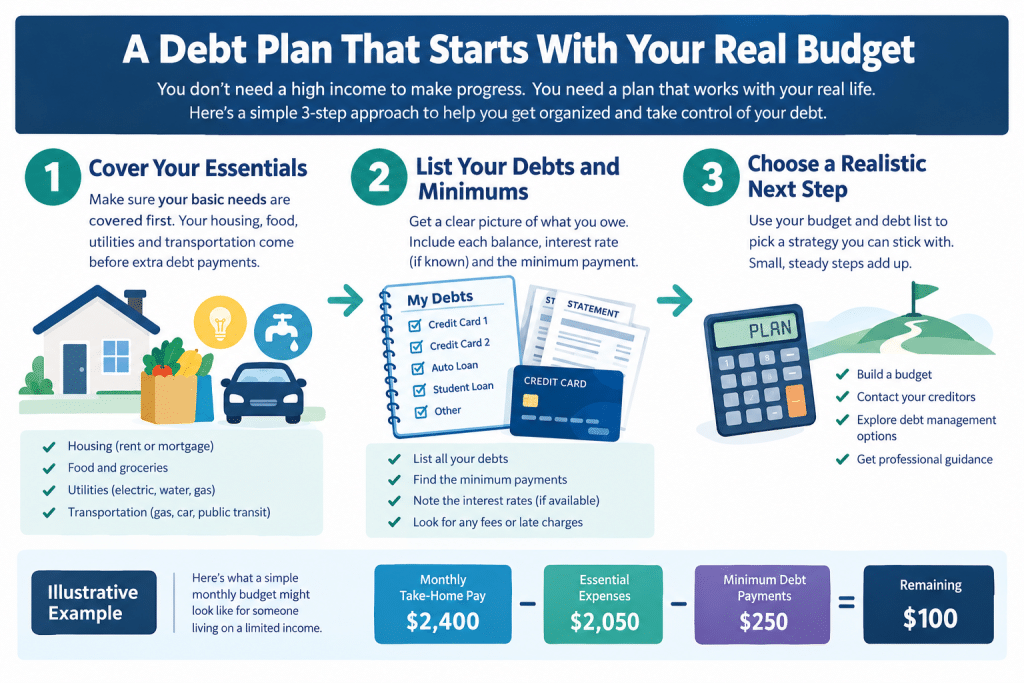
Start with your monthly take-home pay. Subtract your essential expenses and required debt payments. Then determine whether anything remains.
Example: Getting Out of Debt on $2,400 a Month
Imagine a household with $2,400 in monthly take-home income.
| Monthly Expense | Amount |
|---|---|
| Housing | $950 |
| Utilities and phone | $180 |
| Groceries and household supplies | $350 |
| Transportation | $300 |
| Insurance and medical expenses | $150 |
| Other essential expenses | $120 |
| Total essential expenses | $2,050 |
| Minimum debt payments | $250 |
| Money remaining | $100 |
In this example, only $100 remains after essential expenses and minimum debt payments.
That doesn’t mean the household has failed. It means there is limited room for additional debt payments.
The next step is to determine whether any expenses can reasonably be reduced, whether income can be increased, and whether existing creditors offer more manageable repayment terms.
The figures above are illustrative. Your own expenses and available options may be different.
Remember: If your budget shows that you have no money left over, don’t invent a surplus just to make a repayment plan work. Start with what your finances can actually support.
4. Look for Ways to Prevent Your Debt From Growing
Paying down debt is difficult when new expenses keep adding to your balances.
If possible, look for ways to reduce your reliance on credit cards and other borrowing.
Consider these practical steps:
Review recurring expenses. Look for subscriptions, memberships, or services you no longer use. Canceling an unnecessary expense can free up money every month.
Compare essential service costs. Review phone plans, internet packages, insurance premiums, and other recurring bills. Compare alternatives before making changes to ensure you don’t sacrifice necessary coverage or services.
Plan for irregular expenses. Car repairs, school expenses, medical bills, and annual insurance payments can disrupt even a careful budget. When possible, set aside a small amount for predictable expenses that don’t occur every month.
An unexpected healthcare expense can disrupt even a carefully planned budget. If medical bills are adding to your financial stress, see our guide to what to do if you can’t pay your medical bills for steps to check charges and explore financial assistance.
Avoid replacing one debt with another without a plan. A new loan or credit card may appear to provide temporary relief, but it can create additional costs if the underlying budget problem remains unresolved.
Look for opportunities to increase income. If your schedule and circumstances allow, additional work, overtime, or selling unused items may help. However, earning more isn’t always possible, and it shouldn’t be treated as the only solution.
Small changes can help, but there is a limit to how much you can save by cutting expenses. If your income cannot support your essential costs and debt payments, consider the repayment options discussed later in this article.
5. Choose a Debt Repayment Strategy You Can Maintain
If you have several debts and some money available for additional payments, choosing a repayment strategy can help you make progress.
Two popular approaches are the debt snowball and debt avalanche methods.
The Debt Snowball Method
With the debt snowball method, you organize your debts from the smallest balance to the largest.
You make the required payments on all your debts and direct any extra money toward the smallest balance.
Once that debt is paid off, you apply the amount you were paying toward the next-smallest balance.
The main advantage: Paying off a smaller debt can provide an early sense of progress and motivation.
The potential disadvantage: You may pay more interest overall if larger debts have higher interest rates.
The Debt Avalanche Method
With the debt avalanche method, you organize your debts by interest rate, from highest to lowest.
You make the required payments on all your debts and direct any extra money toward the debt with the highest interest rate.
After paying off that debt, you move to the next-highest rate.
The main advantage: This method can reduce total interest costs when you follow the plan and other factors remain comparable.
The potential disadvantage: If your highest-interest debt has a large balance, it may take longer to see an account paid off completely.
Which Method Is Better on a Low Income?
Neither method automatically solves the problem of having too little money available for debt payments.
If you have only a small amount left each month, choose a strategy that is realistic for your budget.
If motivation is important, the snowball method may be appealing. If reducing interest costs is your priority, the avalanche method may be more appropriate.
If you cannot comfortably cover your minimum payments, focus first on evaluating your financial situation and exploring available assistance.
For a more detailed explanation, see our guide to the debt snowball method.
6. Contact Your Creditors Before the Situation Gets Worse
If you are struggling to make your payments, don’t assume your creditors have no options available.
Contact your credit card companies or lenders and explain your circumstances.
Depending on the creditor and your situation, you may be able to request:
- A temporary hardship arrangement.
- A reduced interest rate.
- A modified payment schedule.
- Relief from certain fees.
- Information about other repayment options.
Available programs and eligibility requirements vary by creditor.
Before agreeing to a new arrangement, ask how it will affect your monthly payment, interest charges, fees, account status, and credit reporting.
Request the terms in writing and keep a record of your conversations.
What Should You Say When Calling a Creditor?
You can use a simple script like this:
“Hello, I’m contacting you because I’m having difficulty keeping up with my current payments. I want to address my balance, but my income and essential expenses are making it difficult to afford the current payment. Could you explain whether you offer any hardship programs, reduced interest rates, or alternative payment arrangements?”
You don’t need to promise a payment you cannot afford. Be honest about your financial circumstances and ask what options are available.
Even if a creditor cannot offer a suitable arrangement, understanding your options can help you decide what to do next.
7. Investigate Nonprofit Credit Counseling and Debt Management Plans
Sometimes, budgeting changes and individual creditor negotiations aren’t enough.
If you have substantial credit card debt, high interest rates, or several monthly payments that are difficult to manage, nonprofit credit counseling may be worth investigating.
A credit counselor can review your income, expenses, debts, and financial goals to help you understand your options.
Depending on your circumstances, those options may include a debt management plan.
What Is a Debt Management Plan?
A debt management plan, commonly called a DMP, is an arrangement administered by a credit counseling organization to help eligible consumers repay enrolled debts.
A typical plan works as follows:
- A credit counselor reviews your financial situation and debts.
- The counselor determines whether a debt management plan may be appropriate.
- The organization contacts participating creditors to request available concessions, such as reduced interest rates or waived fees.
- If you enroll, you generally make one scheduled payment to the counseling organization.
- The organization distributes the payment to your enrolled creditors according to the plan.
A debt management plan is not a new loan. Instead, it provides a structured way to repay participating debts under agreed-upon terms.
Depending on the creditors, program terms, and your circumstances, a plan may make repayment more manageable.
However, a debt management plan is not right for everyone. You need to be able to afford the proposed payment, and the terms and benefits vary.
Ask about fees, participating creditors, repayment duration, account requirements, and the potential effects on your credit before enrolling.
Can Credit Counseling Help If You Have a Low Income?
Potentially, yes.
Credit counseling can be particularly useful when you need help determining whether your current payments are realistic and what alternatives might be available.
A counselor can help you understand your budget and evaluate options rather than assuming that you simply need to spend less.
American Credit Foundation is a nonprofit consumer credit counseling organization that provides debt management assistance.
If your debt payments are becoming difficult to manage, you can learn more about ACF’s program and request a consultation to discuss your circumstances.
8. Understand Your Other Debt Relief Options
Credit counseling and debt management plans are not the only possible solutions.
Depending on your financial situation, other approaches may be worth considering.
| Option | How It Works | Important Consideration |
|---|---|---|
| Debt snowball | Focuses extra payments on the smallest balance first | Can provide motivation, but may cost more in interest |
| Debt avalanche | Focuses extra payments on the highest-interest debt first | Can reduce interest costs, but progress may initially feel slower |
| Creditor hardship program | A creditor may modify payment terms or offer temporary assistance | Availability and terms vary |
| Debt management plan | A credit counseling organization helps administer repayment of enrolled debts | Requires an affordable payment and creditor participation |
| Debt consolidation loan | Combines eligible debts into a new loan | Fees, interest rates, loan terms, and affordability matter |
| Debt settlement | Attempts to negotiate repayment of less than the full amount owed | Can involve significant fees, credit consequences, collection risks, and potential tax consequences |
| Bankruptcy | A legal process that may provide relief from qualifying debts | Has significant legal and financial implications; professional legal advice may be appropriate |
There is no single best option for everyone.
For example, a consolidation loan may help someone who qualifies for favorable terms and can afford the new payment. It may be unsuitable for someone whose income cannot support another loan payment.
Debt settlement can also carry risks, including the possibility of continued collection activity and lawsuits while payments are not being made. Some forgiven debt may have tax consequences, although exceptions can apply.
Bankruptcy may be appropriate in some circumstances, but it requires an individualized assessment of the person’s finances and legal situation.
Before committing to any program, compare the total costs, payment requirements, risks, and likely outcomes.
For a more detailed comparison, read our guide to debt relief options.
9. What If You Simply Cannot Afford Your Debt Payments?
This is one of the most difficult financial situations to face.
You may already have reduced your spending, created a budget, and stopped making unnecessary purchases. Yet your income still isn’t enough to cover your essential expenses and required debt payments.
If that describes your situation, you may need a different approach.
Start With Your Immediate Financial Needs
Make sure you understand which expenses are essential and what consequences could follow from missing particular payments.
If you are at risk of losing housing, transportation, utilities, or other necessities, seek appropriate assistance and contact the relevant providers as soon as possible.
If you cannot pay every bill, avoid making decisions based solely on which creditor is contacting you most frequently. Consider the consequences of each missed payment and seek qualified guidance when necessary.
Ask Creditors About Available Relief
Explain your situation and ask whether they can offer an affordable arrangement.
Do not agree to a payment that would prevent you from meeting basic living expenses.
If a proposed arrangement is unaffordable, explain that and ask whether other options are available.
Consider Speaking With a Credit Counselor
A qualified credit counselor can help you review your debts, income, expenses, and repayment options.
Depending on your circumstances, the counselor may determine that a debt management plan is appropriate, suggest other approaches, or explain why a particular program is unlikely to solve your problem.
The important thing is to understand your options before committing to a solution.
Don’t Assume That You Have Failed
Having more debt than your income can reasonably support is a financial problem that requires a practical response.
It is not a measure of your worth or character.
The objective is to find a sustainable way forward, protect your essential needs, and avoid making the situation worse.
If you need help evaluating your options, American Credit Foundation offers a starting point for discussing your debt management needs.
Frequently Asked Questions About Getting Out of Debt on a Low Income
How can I get out of debt if I have no extra money?
Start by reviewing your income, essential expenses, and debt payments. Contact creditors to ask about hardship arrangements, and consider nonprofit credit counseling to evaluate whether a debt management plan or another option may be appropriate.
If you have no money available for additional payments, you may need to address the affordability of your current obligations before focusing on accelerated repayment.
How can I pay off debt while living paycheck to paycheck?
Begin by tracking your actual spending and identifying which expenses are essential. If possible, reduce unnecessary costs without sacrificing basic needs.
Then review your debts and interest rates, contact creditors about potential relief, and choose a repayment strategy that fits your budget.
If minimum payments are already unaffordable, explore professional guidance rather than relying exclusively on spending cuts.
Should I pay off debt or save money first?
The answer depends on your circumstances.
If you have no emergency savings, even a small unexpected expense could force you to borrow again. Building a modest financial cushion may help reduce that risk.
At the same time, high-interest debt can become more expensive the longer it remains outstanding.
Consider your essential expenses, upcoming obligations, interest rates, and ability to handle unexpected costs when deciding how to allocate available money.
Can nonprofit credit counseling help people with low incomes?
Yes, nonprofit credit counseling may help people with limited incomes understand their financial situation and evaluate available repayment options.
A counselor can review your budget and debts, explain different strategies, and determine whether a debt management plan may be appropriate.
The suitability of a particular program depends on your circumstances, participating creditors, and ability to afford the proposed payment.
Is a debt management plan the same as debt consolidation?
No.
A debt consolidation loan replaces eligible existing debts with a new loan. A debt management plan generally organizes repayment of enrolled debts through a credit counseling organization without creating a new loan.
The costs, payment requirements, and potential benefits differ, so compare the terms carefully before deciding.
What should I do if I cannot afford my minimum debt payments?
Contact your creditors promptly and ask about hardship options. Review your essential expenses and determine which obligations require immediate attention.
If you cannot afford the minimum payments even after making reasonable budget adjustments, consider speaking with a qualified credit counselor about your options.
Avoid promising payments you cannot realistically make.
Can I get out of debt on a fixed income?
It may be possible, depending on the amount and type of debt, your essential expenses, interest rates, and available repayment options.
Start by creating a realistic budget and reviewing your debts. If your income cannot support your current payments, contact creditors and investigate credit counseling or other appropriate assistance.
A sustainable plan is more useful than an aggressive repayment schedule you cannot maintain.
Take the Next Step Toward Managing Your Debt
Getting out of debt on a low income isn’t always easy, and there may not be a quick solution.
But understanding your finances, protecting essential expenses, exploring repayment strategies, and seeking help when needed can give you a clearer path forward.
You don’t have to figure everything out on your own.
If your credit card payments are difficult to manage, or you’re unsure which debt relief options make sense for your circumstances, American Credit Foundation can help you explore your options.
Request a free debt consultation to discuss your situation and learn whether a debt management plan or another approach may be appropriate.
Your first step doesn’t have to solve every financial problem. It just needs to move you toward a more manageable plan.