

“How to get out of credit card debt without ruining your credit” involves using structured repayment strategies—such as the debt snowball or debt avalanche—combined with responsible financial tools like Debt Management Plans (DMPs), credit card hardship programs, and credit counseling. The objective is to eliminate your balances while preserving (or even improving) your credit score by ensuring timely payments, maintaining low utilization rates, and avoiding harmful tactics like settlement or bankruptcy.
Are credit card bills stressing you out? Do you want to pay off your debt, but you’re scared it might hurt your credit score?
You’re not alone. Many people feel the same way. The question most ask is: How to get out of credit card debt without ruining your credit?
The good news is this: You can pay off your credit card debt AND keep your credit score safe. In fact, doing things the right way might even help your score go up!
Let’s talk about how you can do this step by step, but first:
What Is a Credit Score and Why Does It Matter?
Your credit score is like a grade that shows how well you handle money you’ve borrowed. Lenders (like credit card companies and banks) look at your score to decide if they should let you borrow more money—or give you a loan. The higher your score, the better!
How Does Average Credit Card Debt and Payment Vary by Age Group?
You might wonder how your credit card debt stacks up compared to others your age. Let’s break it down by age group so you can see where you stand:
- Ages 18–25: People in this group tend to have around 3 open credit cards, with an average total balance of about $8,450. Their average monthly credit card payment? About $269.
- Ages 26–35: As folks get a bit older, both balances and the number of cards usually increase. Here, the average is 5 cards and nearly $11,900 in balances, with a $369 payment each month.
- Ages 35–50: At this stage, many carry about 6 credit cards and an average balance of $16,900, making monthly payments around $431.
- Ages 51–65: This group carries about 8 cards with balances nearing $17,700, and monthly payments average $549.
- Ages Over 65: Older adults also average 8 credit cards, with balances a bit over $17,900 and monthly payments of $510.
- Overall average: Across all these groups, the typical person has 7 cards, a total balance of roughly $15,100, and a monthly payment around $424.
This shows how debt and payments often grow with age—and why it’s so important to develop healthy credit habits early on. Managing debt well at any stage can make a big difference for your financial health down the road.
Typical Credit Card Habits by Age Group
How much credit card debt do people carry at different stages of life? Let’s take a closer look at the numbers—not to scare you, but to help you see you’re not alone, no matter your age.
If you’re just starting out (ages 18–25), the average debt relief seeker has around three open credit cards and owes about $8,500 total, with a monthly payment near $270.
Those in their late 20s or early 30s usually carry five cards and see their balances rise to nearly $12,000, paying roughly $370 each month.
As people reach their mid-30s to 50s, credit cards pile up to about six, and debts jump to more than $16,900, meaning monthly payments climb above $430.
Folks aged 51 to 65—and even those over 65—tend to have around eight cards, with average balances closing in on $18,000 and monthly payments of $500 or more.
When you add it all up, most debt relief seekers juggle about seven cards, carry balances around $15,000, and face monthly payments just above $420.
Whether you’re just out of college or nearing retirement, these patterns are more common than you might think. And the good news? The strategies we’re talking about can help—no matter your age or your starting point.
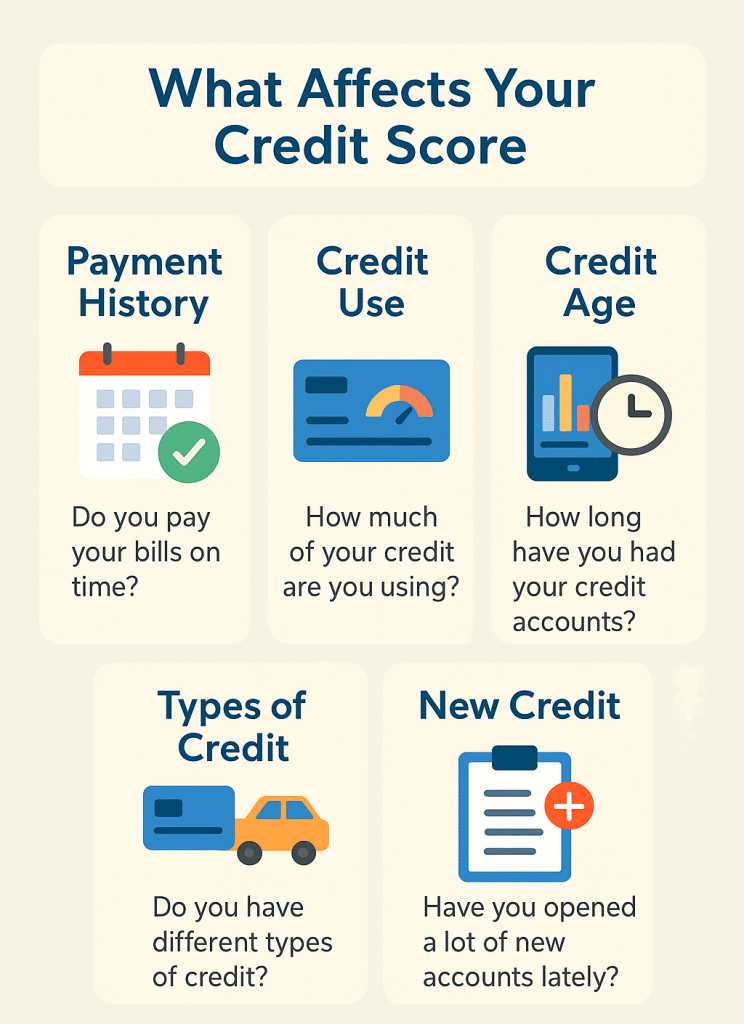
There are five main things that make up your credit score. Let’s break them down:
Payment History (This is the MOST important)
Do you pay your bills on time?
– Every time you pay a credit card, loan, or other bill late, it gets reported to the credit bureaus.
– A late payment can hurt your score—especially if it’s more than 30 days late.
– If you always pay on time, your credit score can go way up over time.
Tip: Set reminders or use auto-pay to never miss a payment!
Staying On Top of Your Payments
- Keep your debt organized. Try using a simple spreadsheet, notebook, or budgeting app to track due dates and balances.
- Set up direct payments. Cover at least the minimum payment each month, and pay more if you can.
If you do miss a payment, you usually have about 30 days before it’s reported as overdue. To protect your credit, pay the minimum as soon as possible.
Pro tip: Making minimum payments keeps your account in good standing, but interest keeps adding up on the remaining balance. Paying more—ideally the full balance—will save you money on interest and may give your score a boost by lowering your credit utilization.
Credit Use (Also called “credit utilization”)
How much of your credit are you using?
– This means how much money you owe compared to how much credit you’re allowed to use.
– Example: If your credit card has a $1,000 limit and you’re using $800, you’re using 80%—which is high!
– Experts recommend using less than 30% of your limit. So for a $1,000 card, that means staying under $300.
Tip: Paying your balance down helps your score go up.
Watch out for maxed-out cards
If you’re getting close to the limit on any card—say, 95% used—even if you’re making minimum payments, lenders see this as risky. A single card that’s nearly maxed can hurt your credit, even if your overall credit use isn’t too high. Try to spread purchases out and avoid fully maxing out any one card.
Only making minimum payments?
While paying at least the minimum keeps your account current, it means interest keeps building up on the rest of your balance. Over time, you could end up paying much more than you originally spent, and carrying large balances month after month can also drag your score down. Work towards paying more than the minimum—ideally, pay off the full balance each month if you can.
Credit Age (Also called “length of credit history”)
How long have you had your credit cards or loans?
– The longer your accounts have been open, the better it looks.
– This shows that you’ve had credit for a while and know how to manage it.
– If you close an old account, it can actually lower your average credit age and hurt your score.
Tip: Even if you don’t use an old card much, keeping it open can help your score.
Types of Credit (Also called “credit mix”)
Do you have more than one kind of credit?
– There are two main types:
– Revolving credit (like credit cards)
– Installment loans (like car loans, student loans, or mortgages)
– Having a mix of different credit types shows that you can handle different responsibilities.
Note: You don’t need all kinds of credit—but having more than one type can help.
New Credit (Also called “recent inquiries”)
Have you opened a lot of new credit accounts recently?
– Every time you apply for a credit card or loan, it’s called a “hard inquiry.”
– Too many new accounts or hard inquiries in a short time can make lenders nervous.
– It might look like you’re taking on more debt than you can handle.
Tip: Only apply for credit when you really need it.
Bottom Line
To build a strong credit score:
– Pay on time
– Use only some of your credit
– Keep old accounts open
– Have a healthy mix of credit types
– Avoid applying for too much at once
Important: Using credit cards isn’t bad. What matters is how you use them.
Why You Should Consider All Your Debts—Not Just Credit Cards
When you’re trying to clean up your finances, it’s easy to focus just on those high-interest credit cards. But here’s the thing: your mortgage, car loan, and even student loans are all big pieces of your financial puzzle.
For example, mortgage debt is a huge part of most families’ expenses. According to recent data from the Federal Reserve, nearly half of families carry some kind of home loan—and the average mortgage balance is well into six figures! That means your monthly payment isn’t just another bill; it’s probably your single biggest expense.
Ignoring these bigger loans might leave you feeling like you’re winning with your credit cards, but your total debt load could still be weighing you down.
Here’s why it matters:
- Your Credit Score Looks at Everything: Lenders don’t just check your credit cards; they look at your entire portfolio of debt—including home and auto loans—when you apply for new credit or a mortgage.
- Monthly Budgets Need the Whole Picture: You want your debt-payment plan to fit your real life, not just one piece of it. Factoring in your mortgage, loans, and credit cards helps you avoid surprises and stay on track.
- The Impact on Your Financial Goals: If you only focus on one debt, others can grow in the background—or crowd out goals like saving for retirement or emergencies.
Bottom line: Real relief—and a healthier credit score—comes from taking all your debts into account. Don’t leave out the big stuff when planning your way to financial freedom!
Now onto the steps on how to get out of credit card debt without ruining your credit.
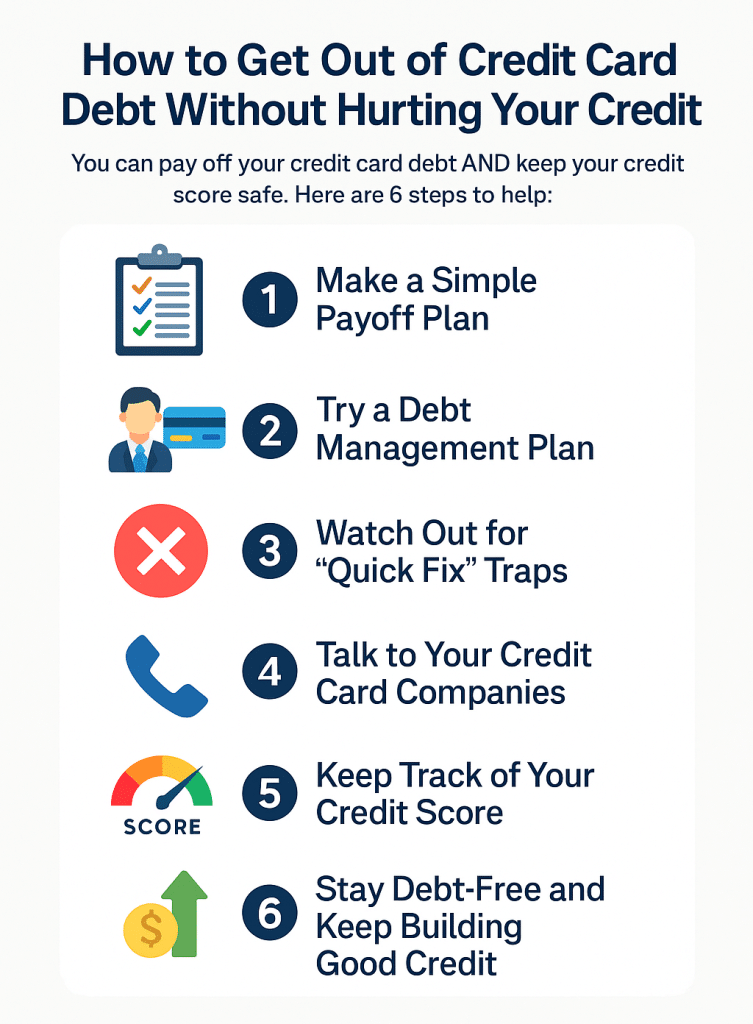
Step 1: Make a Simple Plan to Pay Off Your Debt
You don’t have to guess your way out of debt. There are smart ways to do it.
Option 1: The Snowball Method
This means you pay off your smallest debt first, while making minimum payments on the rest. Once the first card is paid off, move to the next smallest. It’s great because you feel proud and motivated quickly.
Option 2: The Avalanche Method
With this one, you pay off the card with the highest interest rate first. This saves you more money over time.
Both work. Just choose the one that feels right for you. And no matter what—always pay at least the minimum on every card so your credit doesn’t get hurt.
Tip: Set reminders or auto-pay so you never miss a payment!
Other Paths: Debt Settlement and Bankruptcy
If you just can’t make payments and things feel overwhelming, there are still options—especially if you’re deep in financial hardship.
- Debt settlement is when you (or a company you hire) work with your creditors to agree on paying less than you owe. Credit card companies sometimes accept a lump sum that’s lower than your total balance. It’s not guaranteed, and it can impact your credit score, but it could mean a big reduction if you really can’t keep up.
- Bankruptcy is a legal step that can erase or reorganize your debts. It’s usually seen as a last resort, because it has long-term effects on your credit. But for some, it’s the fresh start they need after other options haven’t worked.
If you’re considering either of these, it’s smart to talk to a nonprofit credit counselor or a qualified attorney so you understand exactly what’s involved and what it could mean for your future.
Now let’s talk about another debt relief option that can help you stay on track and protect your credit:
Step 2: Try a Debt Management Plan (DMP)
If your debt feels too big or too hard to handle, you’re not stuck. A Debt Management Plan can help.
Who Should Consider a Debt Management Plan?
A Debt Management Plan (DMP) isn’t right for everyone—but it can be a real lifesaver for certain folks.
You might be a good candidate for a DMP if:
- You’re feeling overwhelmed by your monthly credit card payments but still have steady income.
- You want to avoid bankruptcy or debt settlement, and pay your cards off in full over three to five years.
- You’re struggling to keep up with high interest rates, making it impossible to chip away at your balances.
- You’re committed to making regular monthly payments (often a bit higher than your current minimums) and are ready to stick to a spending plan.
- You could use some hands-on support—credit counselors guide you through budgeting, negotiating with creditors, and building good money habits.
Heads up: With a DMP, you’ll likely need to close most of your credit cards, which could temporarily dip your credit score. But making on-time payments and reducing your debt over time can help your credit bounce back.
If that sounds like you—especially if you’re ready to tackle your debt once and for all—a DMP is worth considering.
Here’s how it works:
– A credit counselor talks to your credit card companies.
– They ask for lower interest rates or smaller monthly payments.
– You make one easy monthly payment, and the counselor sends it to your creditors.
It’s not a loan. It’s a way to organize your debt so you can handle it better.
Most of the time, a DMP won’t hurt your credit. It might even help because you’re paying on time and reducing your debt.
Step 3: Watch Out for “Quick Fix” Traps
Some offers sound helpful—but can actually make things worse.
Debt Settlement
This is when a company offers to pay less than you owe. It sounds great, but it can hurt your credit score a lot, and there may be hidden fees or taxes.
Here’s how it generally works: You (or a company you hire) try to negotiate with your creditors to accept a lump sum that’s less than your total balance. Creditors might agree if they think they’re not likely to get the full amount otherwise.
What to watch out for:
- Credit score impact: Most people stop making payments while saving up for a settlement offer. Missing these payments can seriously damage your credit score. Even after a settlement, your credit report will show the debt as “settled,” which can stick around for up to seven years from your first missed payment.
- Tax implications: If any portion of your debt is forgiven, the IRS might consider that amount taxable income—unless you’re insolvent (meaning you owe more than you own).
- Timeline: During the process, your accounts typically go delinquent, which lowers your score. Once settled, they’re marked as such, but the negative impact lingers.
- Recovery: On the upside, once you complete the settlement, money you were putting toward debt can be redirected to savings or making on-time payments, which is the first step in rebuilding your credit.
Debt settlement can make sense if you’re struggling with serious debt, don’t qualify for bankruptcy, and have limited repayment options. Just be sure to weigh the risks before jumping in.
Timeline: How Debt Settlement Affects Your Credit
Wondering how debt settlement shows up on your credit report? Here’s what usually happens:
– During the settlement process, your accounts will likely be marked as late or past due because you’re not paying the full required amount.
– This period can have a pretty big negative effect on your credit score—sometimes for several months or longer.
– Once a settlement is reached, those accounts won’t say “paid in full.” Instead, they’ll show as “settled” for less than the full balance on your credit report (thanks, Equifax and Experian for spelling that out).
Remember: The hit to your credit score can start early, and the “settled” mark can stick around for years. It helps you move on from the debt, but it doesn’t make it disappear from your history right away.
Bankruptcy
This should be your very last option. It stays on your credit report for up to 10 years. Filing for bankruptcy comes with serious consequences for your credit profile:
- Your credit score will drop significantly, often by more than 100 points.
- The bankruptcy remains on your report for a decade, continuing to affect your ability to qualify for loans, credit cards, or even rental housing.
- Credit options become much more limited and, if you do qualify, expect higher interest rates and stricter terms until the bankruptcy ages off your record.
In short, bankruptcy can provide relief from overwhelming debt, but the long-term impact on your financial life is substantial. Consider every alternative before choosing this path.
Balance Transfer Cards or Debt Consolidation Loans
Sometimes these can help, but they’re tricky. If you don’t use them wisely, you might end up with more debt, not less. Let’s break it down:
- Simplified Payments: Debt consolidation loans can roll multiple bills into one, making life a little less hectic each month.
- Lower Interest, Maybe: If you qualify—usually by having a decent credit score and a manageable debt-to-income (DTI) ratio—you might snag a lower interest rate than your current cards.
- Short-term Credit Score Dip: Applying for a new loan or card means a hard inquiry on your credit report. It’s a minor ding, and typically only lingers for a year (though it’s visible for two).
- Potential Score Boost: Paying off your cards drops your credit utilization, which can actually help your credit score—if you don’t rack up new balances right away.
- Mixing Up Your Credit: Having both installment loans and revolving credit (like cards) can be a plus for your credit mix.
Just remember: missing payments on the new loan or continuing to use your old cards can put you right back where you started—or worse. Used smartly, these tools can help you get ahead. Used carelessly, they’re just another shovel.
How Finishing a Debt Settlement Program Helps You Bounce Back
Once you complete a debt settlement program, you’ll finally have some breathing room in your budget. That extra money you used to send to creditors? Now you can put it toward something positive—like building an emergency savings fund or making sure all your other bills are paid on time. Both of these steps are key for a solid financial foundation and can even help your credit score start to recover.
Plus, as you focus on paying your bills when they’re due, future lenders will see you as more responsible. Little by little, you can turn things around and put yourself back in control of your money.
Should You Use Retirement Savings to Pay Off Credit Card Debt?
Thinking about dipping into your 401(k) or IRA to pay your credit cards? Think twice.
Here’s why it’s usually a bad move:
– When you take money from retirement accounts early, you’ll likely pay taxes and penalties (ouch—there goes even more of your money).
– Retirement funds are built to help you when you’ve stopped working, not to bail out today’s debt. Once you spend them, it’s very difficult to catch up later.
– You’re trading short-term relief for long-term risk—and no one wants to reach retirement with less saved up.
Unless you’ve exhausted every other safe option, leave your retirement savings alone. There are safer, smarter ways out of credit card debt.
Heads Up: Forgiven Debt and Taxes
It’s important to know: if a lender settles your credit card debt for less than you owe, the amount that’s forgiven might count as income when you file your taxes. That means you could get a surprise tax bill for the cancelled debt.
But there’s an exception called “insolvency.” If your total debts are more than all your assets (things you own, like cash, cars, and property), you may not have to pay taxes on the forgiven amount. The IRS even has a worksheet to help you figure this out—see for details.
If you’re not sure whether you qualify, it’s smart to check with a tax professional or review . That way, there are no surprises at tax time!
What Is Chapter 7 Bankruptcy—and Who Can Use It?
If you’re overwhelmed by debt and can’t see a way out, Chapter 7 bankruptcy could be a last-resort option. It’s sometimes called “liquidation” bankruptcy, and it’s designed to wipe out most types of unsecured debt—like credit cards, personal loans, and medical bills.
But not everyone can file for Chapter 7. There’s a “means test”—basically, a look at your income and expenses to see if you really can’t afford to pay anything back. If your income is too high, you might not qualify and will have to look at other options.
Here’s what happens if you file:
- You may have to sell some of your belongings (things like a second car or valuable collectibles, but usually not your basic household necessities).
- Your credit score will drop, and the bankruptcy will show up on your credit report for up to 10 years.
- Getting new credit will be much harder and more expensive during that time.
Chapter 7 bankruptcy is typically for people who owe a lot, have little they could sell, and can’t make even reduced monthly payments. If you think this sounds like you, talk to a qualified bankruptcy attorney—just to make sure you know all your options and what to expect next.
Step 4: Talk to Your Credit Card Companies
Are you struggling to make payments? Don’t hide from it. Call your credit card company and ask for help.
Many companies have hardship programs that:
– Lower your interest rates
– Give you more time to pay
– Help you avoid late fees
These programs aren’t usually advertised, so you’ll need to call the number on the back of your card or reach out through your account’s customer service line. When you talk to them, explain your situation honestly—they hear from people in tough spots every day and may be able to offer temporary relief until you get back on your feet.
A hardship program might mean smaller payments, waived late fees, or even a pause on your payments for a short time. Most of the time, if you set this up before you fall behind, it won’t hurt your credit score—though lenders may note on your report that you’re enrolled in a hardship program. This usually isn’t as damaging as missing payments or defaulting, but it might make it a little harder to open a new account while you’re in the program.
The key is to ask for help before you get too far behind. You might be surprised at how much breathing room your lender can give you.
Try saying something like:
“Hi, I’m trying to stay current, but I’m having a hard time. Do you have any programs that could help me right now?”
What Is Forbearance—and How Can It Help?
Sometimes, your credit card company may offer something called forbearance if you’re going through a rough patch. Here’s what that means: you and your creditor agree to temporarily change up your payments so things are a bit more manageable. Usually, this looks like making smaller payments, or even pausing payments altogether, for a set period—often around 6 to 12 months.
During forbearance, your account generally stays open and in good standing as long as you stick to the new agreement. This option can give you breathing room without defaulting. Just remember, interest may keep building up, so ask about how this will affect your balance and repayment timeline before you say yes.
If you’re interested, simply call your card issuer and ask if they have a forbearance or hardship program that fits your situation. Every little bit of relief can help keep you on track toward being debt-free.
Get It in Writing
If your credit card company agrees to help—say, by lowering your rate or changing your payment plan—make sure you get the details in writing. Why? Because having written proof protects you if there’s ever a mix-up down the road. Ask for a confirmation email, a letter, or a reference number every time you set up a new agreement.
Hold on to these documents. If anything changes or you’re ever questioned about what was promised, you’ve got backup. It’s a simple step that can save you a lot of stress later.”
Step 5: Keep Track of Your Credit Score
You don’t have to guess if your score is going up or down. There are free ways to check your score:
– AnnualCreditReport.com – Check your full credit report once a year for free.
– Credit Karma, Credit Sesame, or your bank’s app – These let you see your credit score anytime.
Also, look for mistakes in your report. If you see something wrong, you can ask to fix it—and that might boost your score!
How Long Does It Take to See Your Credit Improve?
So, how fast does your credit score bounce back after you’ve paid off your debt? The good news: you might start noticing improvement within a few months if you’re consistently making payments on time and reducing what you owe. Yep, even with old negative marks still hanging around, your efforts can add up faster than you think.
- On-time payments and lower balances can begin to make a difference in as little as 2–3 months.
- Negative history, like missed payments or collections, might stick around for several years—but your recent good habits matter more and more as time goes on.
- Keep checking your score regularly (using tools like Credit Karma or your bank’s app) to track your progress and catch any errors early.
The bottom line: while big improvements take patience, every month of smart choices makes a real difference. Stick with your plan—your credit score will thank you.
Step 6: Stay Debt-Free and Keep Building Good Credit
Once you’ve paid off your cards, don’t stop there! Let’s keep that progress going:
– Don’t close your old credit cards (unless they have big yearly fees). Keeping them open helps your credit history.
– Use your card sometimes and pay it off in full.
– Save money for emergencies, so you don’t have to use credit cards again.
Final Thoughts: You’ve Got This
You don’t need to feel stuck. You don’t need to wreck your credit to get out of debt. With a smart plan, a little help, and steady steps, you can become debt-free and keep your credit score safe.
Need Help Getting Started?
At American Credit Foundation, we’ve helped thousands of people just like you take back control of their money. Our trained credit counselors are friendly, patient, and best of all—their help is free.
Click here to contact us today and start your journey to freedom and find out: How to get out of credit card debt without ruining your credit.